
Last updated: July 14, 2026
Quick Answer: DIY tree removal is one of the most dangerous tasks a homeowner can attempt. Falling trees, chainsaw injuries, and electrocution from power lines kill and seriously injure people every year, including experienced workers. Unless the tree is small, clear of structures, and well away from utility lines, hiring a licensed, insured professional is the safer and often cheaper choice in the long run.
Key Takeaways
- Tree work ranks among the top three deadliest civilian occupations, with fatality rates significantly higher than the national average for all workers [9]
- The two leading causes of fatal tree-work injuries are being struck by falling objects and falls, both of which are far more likely when an untrained homeowner is doing the cutting [3]
- Electrocution accounts for roughly 14% of tree-worker fatalities; DIY removers near SWEPCO lines face this risk without any utility training or clearance procedures [7]
- "Barber-chairing", a trunk splitting vertically and kicking back, can happen in seconds and is nearly impossible to survive at close range [8]
- Trees over 15 feet tall, within 10 feet of any structure, leaning toward property, or growing near power lines should never be DIY projects [2]
- Homeowner's insurance may deny claims if a tree falls on your house during an unpermitted DIY removal
- Professional tree removal in Northwest Louisiana typically runs $300,$1,500 depending on size, location, and complexity, far less than a structural repair bill
- Permits are required in some Caddo Parish and Shreveport city zones; skipping them can mean fines
- A certified arborist can assess whether a tree actually needs to come down, saving you money if it doesn't
What Are the Main Dangers of DIY Tree Removal?
DIY tree removal is dangerous because trees are heavy, unpredictable, and unforgiving. A single mistake in cut placement, fall path calculation, or footing can result in death or serious injury within seconds.
Here are the core hazards:
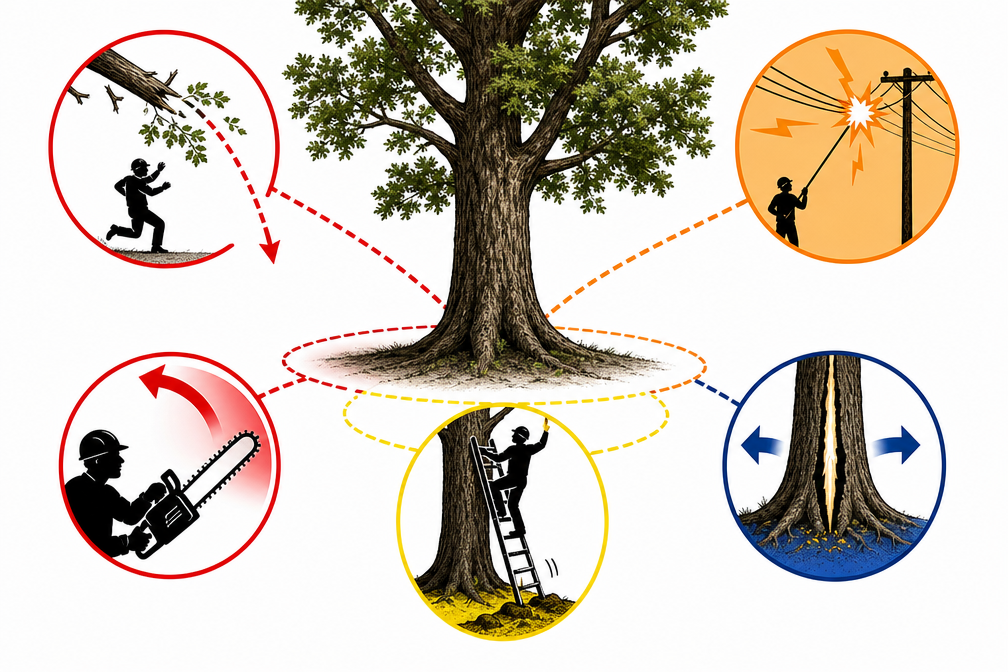
- Uncontrolled fall path. A tree rarely falls exactly where you expect. Root decay, internal rot, and uneven weight distribution all shift the outcome. One Loblolly Pine in South Highlands can weigh several tons, if it goes the wrong direction, it takes out a fence, a car, or a roof.
- Chainsaw kickback. Chainsaws cause thousands of injuries every year [2]. Kickback, when the bar tip contacts wood and snaps back toward the operator, happens in a fraction of a second. Without training and proper body positioning, it's a trip to the ER.
- Falls from height. Ladders on uneven ground next to a tree trunk are unstable. Add the vibration of a running chainsaw and the shifting weight of cut limbs, and falls become likely [2].
- Struck by falling limbs. Dead branches, called "widow makers," can dislodge without warning the moment you start cutting below them. This is the leading source of fatal struck-by incidents in tree work [3].
- Electrocution. Any tree growing near a SWEPCO service drop or overhead line is a live hazard. Contact with electric current accounts for about 14% of tree-worker fatalities, and two-thirds of those involve indirect contact, a branch or pole saw touching a line [7].
Can You Die from DIY Tree Removal?
Yes. People die every year attempting to remove trees themselves. Tree work is one of the top three deadliest civilian jobs even for trained professionals with proper equipment [9]. For untrained homeowners, the risk is substantially higher.
One of the most lethal failure modes is "barber-chairing", when a leaning or brittle trunk splits vertically instead of falling cleanly, sending a massive wood slab backward at high speed toward the person holding the saw [8]. This is more common with storm-damaged trees, trees with internal decay, and any species prone to tension wood, including Water Oaks and Sweetgums common across Caddo Parish.
The rule is simple: if the tree is large enough to kill you when it falls, it's large enough to require a professional.
What Injuries Happen Most from Tree Removal?
The most common serious injuries from tree removal are lacerations from chainsaw contact, crush injuries from falling trunks or limbs, and fall injuries from ladders or elevated positions [3][5].
Specific injury patterns include:
- Deep lacerations to the thigh, arm, or hand from chainsaw contact
- Broken bones and spinal injuries from falls off ladders
- Crush injuries when a trunk rolls or a limb drops unexpectedly
- Head trauma from struck-by incidents
- Electrical burns or cardiac arrest from power line contact [7]
Professional crews wear chainsaw-rated chaps, hard hats, face shields, and steel-toed boots. Most homeowners have none of that.
What Equipment Do You Need to Safely Remove a Tree?
Safe tree removal requires far more than a chainsaw and a ladder. Professional crews use a combination of specialized tools that most homeowners don't own and wouldn't know how to use safely.
Minimum equipment for any significant removal:
- Chainsaw with proper bar length for trunk diameter
- Chainsaw-rated protective chaps and gloves
- Hard hat with face shield and hearing protection
- Climbing harness, ropes, and rigging hardware for work above ground
- Wedges and felling levers to control fall direction
- Wood chipper or haul-away capacity for debris
- Stump grinder for below-grade removal
For trees near structures or power lines, add: aerial lift or bucket truck, rigging blocks and lowering lines, and in some cases, a crane. That's tens of thousands of dollars in equipment. Our professional tree removal service brings all of it to your property.
DIY Tree Removal vs. Hiring a Professional: A Direct Comparison
| Factor | DIY Removal | Professional Crew |
|---|---|---|
| Safety | High risk, no training, no PPE | Trained, certified, full PPE |
| Equipment | Consumer chainsaw, basic ladder | Rigging, lifts, chippers, cranes |
| Liability | You bear all costs if something goes wrong | Fully insured, damage covered |
| Permits | Often overlooked, fines possible | We handle permit research |
| Debris cleanup | Your problem, multiple truck loads | Included or add-on service |
| True cost | Low upfront, potentially catastrophic | $300,$1,500, predictable |
Can I Remove a Small Tree Myself?
For a small tree, under 15 feet tall, no lean toward structures, no overhead lines within striking distance, and a clear open fall zone, a careful homeowner with the right tools can manage it. That's a narrow set of conditions.
In Shreveport yards, those conditions are rarely all met at once. Most mature trees in Broadmoor, Spring Lake, and Bossier City neighborhoods are close to fences, driveways, or neighboring structures. Even a 20-foot Chinese Tallow, a species that should come down anyway, can cause real damage if it falls wrong.
Choose DIY only if all of these are true:
- Tree is under 15 feet tall
- No structures, vehicles, or fences within the fall zone
- No power lines within twice the tree's height
- You have proper chainsaw safety gear
- The tree is not dead, diseased, or leaning
If even one condition isn't met, call a professional. Our team serves Bossier City and all surrounding communities with free estimates and no pressure.
What Mistakes Do People Make When Removing Trees?
The most common DIY tree removal mistakes are misjudging the fall direction, cutting the notch wrong, and failing to account for overhead hazards [1][8].
Frequent errors that lead to injury or property damage:
- Wrong notch angle or depth. A notch that's too shallow or angled incorrectly removes directional control. The tree falls where gravity takes it, not where you planned.
- Ignoring the hinge. The wood fiber hinge between the notch and back cut controls the fall. Cut through it too early and the tree is unguided.
- Working alone. No one to watch for shifting limbs, no one to call 911.
- Skipping the escape route. Professionals plan two escape paths before the first cut. Most homeowners don't think about this until the tree is already moving.
- Underestimating dead wood. A dead Pecan or Magnolia looks stable until it isn't. Decay weakens the wood unpredictably [8].
Is It Illegal to Remove a Tree on Your Own Property, and Do You Need a Permit?
In many cases, yes, you need a permit, even for trees on your own property. Caddo Parish and the City of Shreveport have tree ordinances that regulate removal of certain protected or heritage trees, and some subdivisions have HOA rules that go further.
Cutting down a tree without a required permit can result in fines. In some cases, you may be required to replace the tree at your own expense.
When to check for a permit:
- The tree is large (generally over 6-8 inches in trunk diameter)
- You're in a historic district or designated green corridor
- The tree is near a public right-of-way
- Your HOA has a tree removal policy
When you call Shreveport Trees for a free estimate, permit requirements are part of the conversation, no surprises after the fact.
How Much Does Professional Tree Removal Cost?
Professional tree removal in Northwest Louisiana typically runs $300 to $1,500 for most residential trees, with larger or more complex jobs going higher. The price depends on tree height, trunk diameter, proximity to structures, and whether stump removal is included.
General cost ranges (estimates):
- Small tree (under 25 ft): $300,$500
- Medium tree (25-50 ft): $500,$900
- Large tree (50+ ft, or near structures): $900,$1,500+
- Stump grinding: $100,$300 additional (see our stump grinding service)
Compare that to the cost of repairing a roof, replacing a fence, or dealing with a neighbor's property damage claim. Honest assessments, fair pricing, that's how we work. Call for a free estimate and get a real number, not a guess.
Tree Removal Insurance and Liability: What Happens If Something Goes Wrong?
If a tree falls on your house during a DIY removal attempt, your homeowner's insurance may deny the claim. Most policies cover sudden accidental damage, but a self-directed removal is a planned activity, and if the insurer determines negligence was involved, you're paying out of pocket.
If the tree hits a neighbor's property, you're personally liable for the damage. That can mean legal action, not just repair costs.
What licensed, insured professionals provide:
- General liability insurance covering property damage during the job
- Workers' compensation covering their crew, not your homeowner's policy
- Documentation for your insurance company if needed
Shreveport Trees is licensed and insured. Every job. If something unexpected happens on your property, it's covered. That's not a marketing line, it's the protection you're paying for when you hire a professional.
How Do Professionals Remove Trees Safely?
Professional tree removal follows a systematic process designed to control every variable that a DIY attempt leaves to chance [2][4].
The professional process:
- Site assessment. Evaluate the tree's lean, root condition, decay, proximity to structures and lines, and the best fall zone.
- Hazard identification. Locate all overhead utilities, underground lines, and nearby structures.
- Equipment setup. Position chipper, establish drop zones, set up rigging if needed.
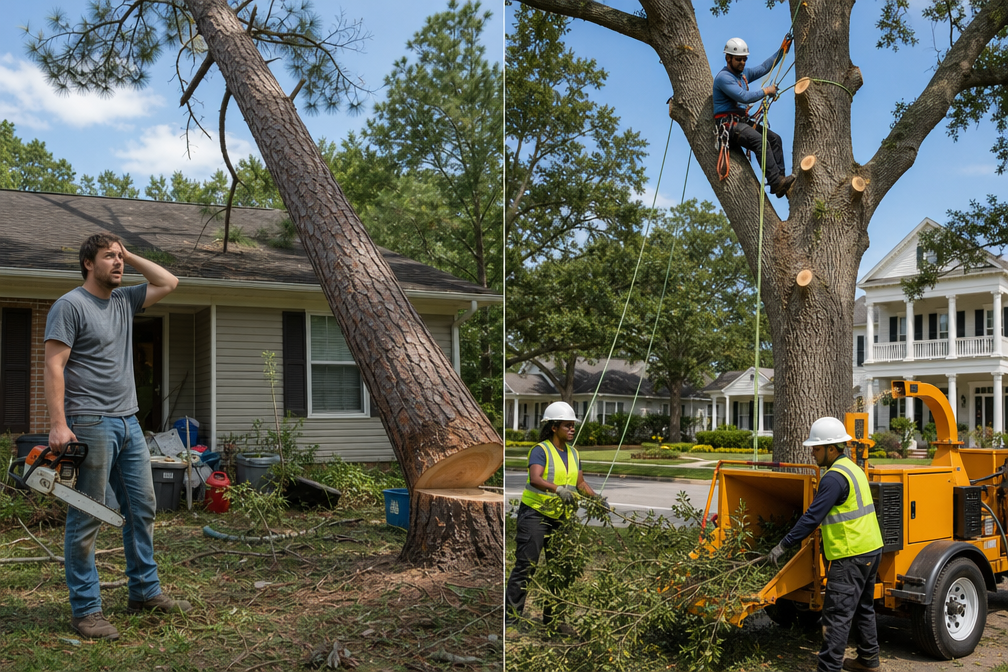
- Sectional removal or full fell. Large trees near structures are taken down in sections from the top, with each piece rigged and lowered. Open-area trees may be felled in one controlled cut.
- Stump handling. Cut flush or grind below grade depending on the plan.
- Debris removal. Chip, haul, or stack, whatever the homeowner needs. See our tree debris cleanup service for full detail.
For storm-damaged trees or emergency situations, the process moves faster but the safety steps don't change. Our 24/7 emergency tree service covers Shreveport, Bossier City, and all of Northwest Louisiana, real people answering, real fast.
How Long Does Professional Tree Removal Take?
Most residential tree removals take two to four hours. A large Loblolly Pine or Bald Cypress near a structure may take a full day, especially if rigging is required. Emergency storm work can move faster when access is clear.
Factors that extend the timeline: tight access for equipment, multiple trees, stump grinding, and debris haul-away. Your estimate will include a realistic time window so you can plan accordingly.
Conclusion
The DIY tree removal dangers that lead homeowners to hire a professional aren't exaggerated, they're documented, repeated, and preventable. A tree that looks manageable from your back porch is a different thing entirely once you're standing next to it with a chainsaw running.
If you have a Water Oak dropping limbs in Broadmoor, a storm-split Post Oak near your Cross Lake property, or a Chinese Tallow that's been taking over your Spring Lake yard, the right move is a free, honest assessment from a crew that knows these trees because we live here too.
Your next steps:
- Call Shreveport Trees for a free estimate, no obligation, no pressure
- Ask about permit requirements for your specific address
- If it's an emergency, we're available 24/7, real people, real fast
- Browse our full tree services including trimming, land clearing, and stump grinding
Your trees, our responsibility. Serving Shreveport, Bossier City, and all Northwest Louisiana.
Call us at (318) XXX-XXXX or request your free estimate online.
Frequently Asked Questions
Q: What is the most dangerous part of removing a tree yourself? Misjudging the fall direction is the single most dangerous mistake. Once a tree starts moving, nothing stops it. Barber-chairing, a vertical trunk split that kicks back toward the cutter, is also frequently fatal [8].
Q: Can a homeowner legally cut down a tree in Shreveport? Sometimes, but not always. Shreveport and Caddo Parish have tree ordinances that require permits for certain removals. Check with the city before cutting, or ask us, we'll tell you what applies to your property.
Q: Does homeowner's insurance cover DIY tree removal accidents? Not reliably. If you're conducting a planned removal and something goes wrong, the insurer may classify it as negligence and deny the claim. A licensed, insured professional protects you from that exposure.
Q: How close to power lines is too close for DIY? Any tree within striking distance of a power line, generally twice the tree's height, should be handled by a professional with utility clearance procedures. SWEPCO lines are live and unforgiving [7].
Q: Is it worth hiring a professional for a small tree? If the tree is under 15 feet, has a clear fall zone, and is well away from structures and lines, a careful homeowner can manage it. If any of those conditions aren't met, a professional is worth every dollar.
Q: How do I know if my tree actually needs to come down? A certified arborist can tell you. Some trees that look dangerous are structurally sound; some that look fine are hollow. If it can be saved, we'll tell you. If it can't, we'll show you why. That's the honest assessment every Shreveport homeowner deserves.
Q: What happens to the stump after tree removal? The stump can be cut flush with the ground or ground below grade with a stump grinder. Leaving a stump invites pests and regrowth, especially with species like Chinese Tallow, which sprouts aggressively from the root system. See our stump grinding page for options.
References
[1] Common Tree Removal Mistakes Homeowners Make - https://pedrostreeserviceca.com/blog/common-tree-removal-mistakes-homeowners-make/ [2] The Dangers Of DIY Tree Removal - https://www.newurbanforestry.com/news/the-dangers-of-diy-tree-removal [3] Tree Work Safety By The Numbers - https://tcimag.tcia.org/safety/tree-work-safety-by-the-numbers/ [4] Reasons You Should Not Do Tree Work Yourself - https://www.atlantaarbor.com/blog/reasons-you-should-not-do-tree-work-yourself/ [5] Tree Trimming Safety Stats And Facts - https://ilt.safetynow.com/tree-trimming-safety-stats-and-facts/?print=pdf [6] Tree Worker Safety Update By The Numbers Another US Vs Them - https://tcimag.tcia.org/safety/tree-worker-safety-update-by-the-numbers-another-us-vs-them/ [7] Tree Worker Safety Update - https://tcimag.tcia.org/safety/tree-worker-safety-update/ [8] Is DIY Tree Removal Safe - https://www.admtreeservices.net/is-diy-tree-removal-safe/ [9] Is Arborist A Dangerous Job - https://arbostar.com/education-hub/is-arborist-a-dangerous-job [10] The Dangers Of DIY Tree Removal - https://goodmorningtreeservice.com/articles/the-dangers-of-diy-tree-removal
0 Comments