
Last updated: July 14, 2026
Quick Answer
Most trees can be saved if less than 50% of the canopy is damaged, the trunk is structurally sound, and the tree poses no immediate risk to people or structures. Remove a tree when it is dead, severely diseased beyond treatment, structurally compromised at the trunk or roots, or positioned where failure would cause serious harm. When in doubt, call a certified arborist before touching anything.
Key Takeaways
- The 50% rule is your baseline: more than half the canopy dead or damaged usually means removal is the right call [5][7]
- Trunk damage exceeding 25% of the circumference, or more than one-third of the interior hollow, signals structural failure risk [6][7]
- A certified arborist evaluates three things: tree condition, failure risk, and what the tree could hit if it falls [3]
- Sudden new lean with soil heaving at the base is an emergency, not a "wait and see" situation [3][9]
- Root damage affecting more than 50% of the root system is very difficult to recover from [7][13]
- Diseases like oak wilt and advanced root rot are rarely reversible, removal protects surrounding trees [3][9]
- Pruning, cabling, and targeted treatment can save structurally sound trees with manageable problems [1][3]
- Dead trees near homes, play areas, or power lines need to come down fast, liability does not wait [9][11]
- Always confirm ownership and local permit requirements before any removal in Caddo Parish [6]
- A free estimate from a licensed, insured arborist costs nothing and can save you thousands
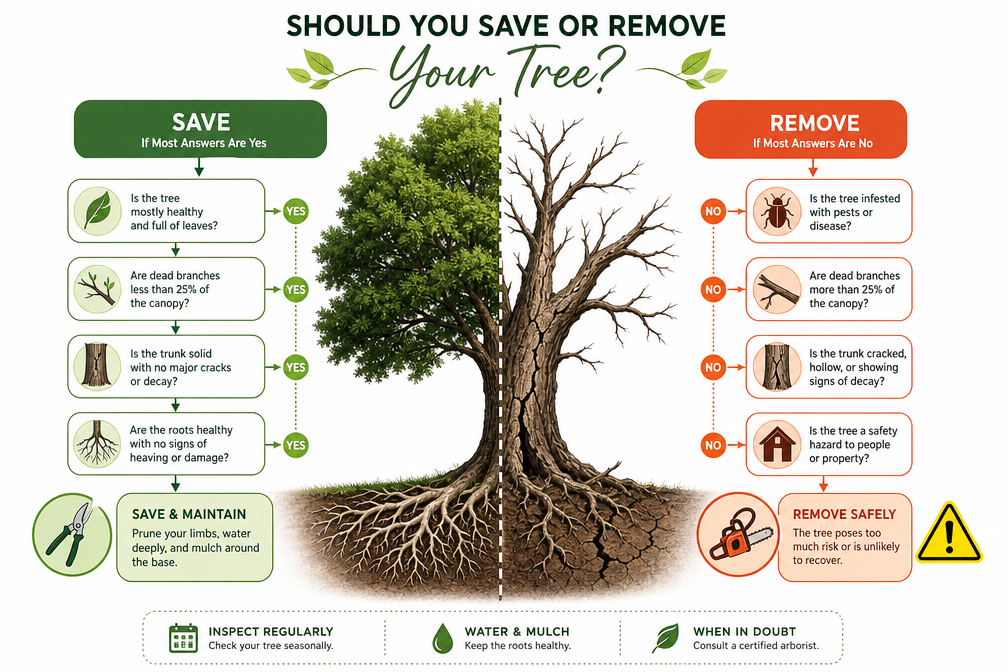
When Should You Remove a Tree vs. Save It?
Remove a tree when keeping it creates unacceptable risk or when the cost of treatment outweighs the tree's long-term value. Save it when the tree is structurally sound, the problem is treatable, and the tree provides real benefit to your property.
That is the core of every When Remove Tree vs Save It Decision Guide, but the details matter. A Water Oak in Broadmoor that has lost 30% of its canopy to a storm may be worth saving with corrective pruning. That same tree with a hollow trunk, a severe lean toward the house, and fungal conks at the base needs to come down.
The decision comes down to three factors [2][4][9]:
- Condition: How healthy is the tree structurally and biologically?
- Risk: What does it fall on if it fails, and how likely is failure?
- Goals: What do you need the tree to do, shade, privacy, aesthetics, and for how long?
When defects and risks outweigh the benefits, removal is the answer. When the tree is sound and the problem is fixable, saving it is almost always cheaper than planting a replacement that will take 20 years to mature.
How Do You Know If a Tree Is Worth Saving?
A tree is worth saving when it has good structural integrity, a treatable problem, and meaningful value to your property. It is not worth saving when structural defects are severe, the location creates serious risk, or the disease has progressed past the point of treatment [1][2].
Use this checklist to assess value:
- Canopy health: Less than 25% damage? Strong candidate for saving. Over 50%? Removal is likely needed [5][7]
- Trunk condition: No cracks, splits, or cavities larger than one-third of the trunk's diameter? Good sign [6][7]
- Root system: No major construction damage, no soil heaving, no severed anchor roots? Likely stable [3][9]
- Species value: A 60-year Pecan or Southern Magnolia in South Highlands is worth fighting for. A Chinese Tallow that seeded itself along your fence line, not so much
- Location: Distance from the house, SWEPCO lines, driveways, and areas where people spend time all affect the calculus [2][9]
Choose to save if: The tree is structurally sound, the issue is limited (one diseased limb, minor pest damage), and removal would cost more than treatment plus monitoring.
Choose removal if: Multiple defects stack up, the tree is close to a structure, and a certified arborist confirms the risk is not manageable.
What Makes a Tree Dangerous and Need Removal?
A tree becomes dangerous when the probability of failure is high AND the consequences of that failure are severe. Both conditions have to be present [3].
Key danger indicators that push toward removal:
- Dead or dying crown with no new growth and brittle, snapping branches
- Vertical cracks or splits running down the trunk
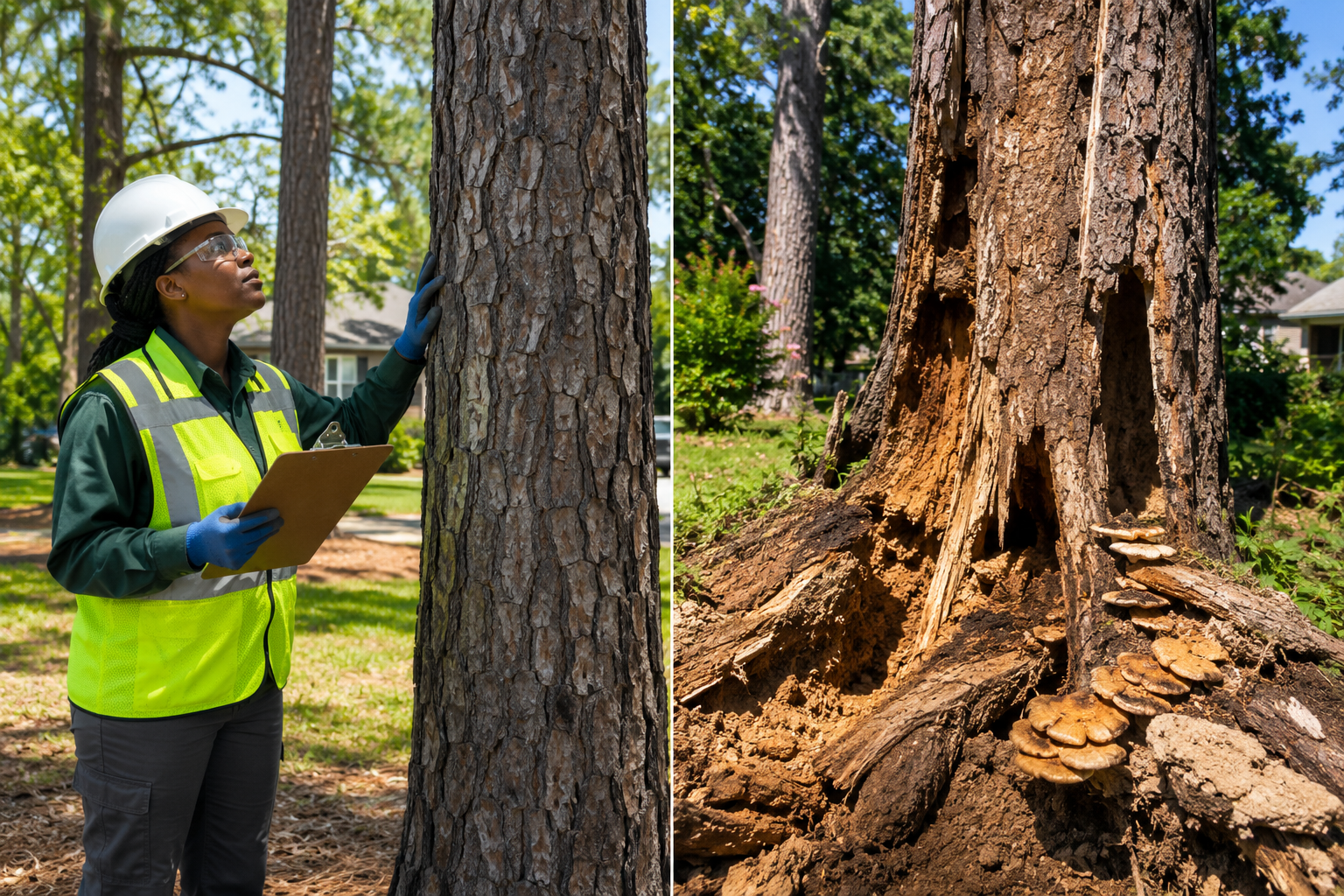
- Fungal conks (shelf mushrooms) growing from the trunk or base, these signal internal decay [6][8]
- Severe lean greater than roughly 15 degrees from vertical, especially if it developed suddenly [3][7]
- Soil heaving at the base, which means the root plate is lifting and the tree is already starting to fall [9]
- Co-dominant stems with included bark at the union, these split under wind or ice load
- Proximity to structures: A Loblolly Pine 10 feet from a Spring Lake home with 40% crown loss is a very different risk than the same tree in an open field
If a tree near your home shows two or more of these signs, do not wait for the next storm. Our emergency tree service is available 24/7, real people, real fast.
Can a Diseased Tree Be Saved, or Does It Need to Come Down?
It depends entirely on the disease, how far it has progressed, and whether treatment can stop it. Some diseases are manageable; others are a death sentence for the tree and a threat to every susceptible tree nearby [3][9].
Diseases where saving is often possible:
- Localized fungal infections caught early
- Anthracnose on Sycamores and Oaks (manageable with pruning and fungicide)
- Certain bacterial infections limited to one scaffold branch
Diseases that almost always mean removal:
- Oak wilt, spreads through root grafts and beetle vectors; an infected Post Oak in Shreveport can kill its neighbors within a season [3]
- Advanced root rot (Armillaria), by the time you see mushrooms at the base, the root system is compromised
- Dutch elm disease, no practical cure once it reaches the vascular system
The rule: if the disease is systemic, fast-moving, and untreatable, removal is not optional, it is responsible stewardship of your property and your neighbors' trees [9][11].
Tree Removal Cost vs. Tree Treatment Cost
Treatment is almost always cheaper in the short term. Removal wins financially when a tree is too far gone and the cost of repeated treatment exceeds the cost of removal plus a replacement planting.
Ballpark ranges for Northwest Louisiana (estimates only, get a free assessment for your specific tree):
| Situation | Typical Approach | Relative Cost |
|---|---|---|
| Single diseased limb, healthy tree | Pruning + treatment | Low |
| 30% canopy loss, sound trunk | Corrective pruning | Low-moderate |
| Advanced disease, 60%+ canopy loss | Removal | Moderate-high |
| Large tree, severe lean, near structure | Emergency removal | Higher |
| Stump left after removal | Stump grinding | Add-on |
The real cost comparison: a $400 treatment that buys three more years on a tree that ultimately comes down anyway costs more than a $900 removal done now. An honest arborist will tell you which scenario you are in. That is exactly what Shreveport Trees does, honest assessments, fair pricing.
How to Tell If a Tree Is Dead or Just Dormant
A dormant tree looks dead but is not. A dead tree looks dead because it is. The scratch test settles most questions: scratch a small section of bark on a younger branch. Green or white tissue underneath means the tree is alive. Dry, brown, or crumbly tissue means that branch is dead [8].
Additional checks:
- Bud test: Dormant trees have firm, intact buds. Dead trees have shriveled, absent, or crumbling buds
- Flexibility: Live branches bend; dead branches snap cleanly
- Bark: Peeling bark that exposes dry wood underneath, with no green cambium layer, is a bad sign
- Timing: If it is April in Shreveport and every other tree on the block has leafed out and yours has not, that is not dormancy
If the scratch test shows dead tissue on multiple branches throughout the canopy, the tree is likely dead or in terminal decline. At that point, the When Remove Tree vs Save It Decision Guide answer is clear: it comes down [6][8].
What Tree Problems Can Be Fixed Without Removing the Tree?
Many common tree problems are fixable without removal. Professional pruning and trimming resolves the majority of issues homeowners call about, and it costs a fraction of removal [7].
Problems that respond well to treatment or pruning:
- Deadwood and crossing branches, standard crown cleaning
- Overgrown canopy near a roofline, directional pruning keeps the tree and protects the house
- One or two diseased limbs, remove the affected wood, treat if needed, monitor
- Co-dominant stems, structural cabling can reduce split risk significantly [3]
- Mild pest infestations, targeted treatment before they escalate
- Storm damage under 50% canopy loss with intact trunk, corrective pruning and time [1][7][10]
Do not try to prune your way out of: a hollow trunk, severe root damage, systemic disease, or a dangerous lean. Those require a different conversation.
When Is Tree Removal Necessary for Safety?
Tree removal is necessary for safety when the risk of the tree failing is high and the target, meaning what it would hit, is a home, a person, a vehicle, or a utility line [3][9].
Non-negotiable removal scenarios:
- Dead tree within striking distance of any occupied structure
- Tree actively leaning toward a home with soil heaving at the base
- Large limbs hanging directly over a roof, driveway, or play area
- Tree roots undermining a foundation or lifting a driveway toward utility lines
- Post-storm damage where more than half the canopy is gone or the trunk is cracked
In Shreveport and Bossier City, storms move fast. A Loblolly Pine that looked fine in March can be a roof hazard by June after one bad system off the Red River. If you are not sure, call before the next storm, not after. View our full tree removal services for more on what the process looks like.
Can You Save a Tree with Root Damage?
Sometimes, but root damage is the hardest problem to recover from. Root systems are the foundation of the tree, damage them severely and the tree loses both its anchor and its ability to take up water and nutrients [3][7].
Factors that determine whether a tree can survive root damage:
- Less than 25-30% of the root system affected? Recovery is possible with reduced pruning and careful watering
- More than 50% of the root system damaged or severed? Structural failure becomes likely, even if the tree looks fine above ground for a year or two [7]
- Roots cut within the drip line during construction? The tree may decline slowly over 3-5 years, this is called construction damage decline
- Roots undermining a foundation or lifting hardscape? The tree and the structure cannot coexist long-term
Root damage near Cross Lake homes during drainage work or near Bossier City driveways during repaving is a common call. The answer depends on how much of the root zone was affected and whether the remaining system can support the tree's size. A soil probe and a professional assessment give you the real picture.
Tree Removal vs. Pruning: Which Should You Do?
Prune when the tree is structurally sound and the problem is localized. Remove when structural defects are severe, the tree is dead or dying, or the risk to people and property is unacceptable [7].
Choose pruning if:
- Less than 25% of the canopy is affected
- The trunk is solid and the root system is intact
- The tree provides significant shade, privacy, or aesthetic value
- The problem is confined to specific branches
Choose removal if:
- Over 50% of the canopy is dead or damaged [5][7]
- The trunk has cracks, cavities, or more than one-third hollow interior [6]
- The tree is dead
- The lean is severe and sudden
- No amount of pruning addresses the underlying structural problem
Pruning a structurally compromised tree is not a solution, it is a delay. Trim it now if it needs trimming, or pay triple to remove it later after it damages something.
Signs Your Tree Is Dying and Cannot Be Saved
These signs, especially in combination, indicate a tree that is past the point of recovery [6][8][9]:
- No leaf-out in spring when surrounding trees of the same species are fully leafed
- Mushrooms or fungal conks at the base or on the trunk
- Bark sloughing off in large sections with no green cambium underneath
- Multiple dead scaffold branches throughout the crown, not just at the tips
- Vertical cracks running the length of the trunk
- Sawdust or bore holes from wood-boring beetles (often a sign the tree is already in severe decline)
- Gradual lean that has worsened over one or two seasons
One of these signs alone may not be fatal. Three or more together, that tree needs to come down, and the sooner the better [6][8].
How Arborists Decide Whether to Remove a Tree
Certified arborists use a structured risk assessment, not a gut feeling. The ISA (International Society of Arboriculture) framework evaluates three things: the likelihood of failure, the size of the part that could fall, and the target it would hit [3][12].
The assessment covers:
- Structural defects, cracks, cavities, co-dominant stems, included bark, root damage
- Tree health and vigor, growth rate, canopy density, response to past pruning
- Site factors, proximity to structures, utilities, and high-use areas
- Species characteristics, some species, like Water Oaks, are known for sudden branch failure even in apparent health
- Owner goals, how long do you need this tree, and what are you willing to invest?
At Shreveport Trees, every assessment follows this framework. We know these trees because we live here too, and we know that a Sweetgum in a Broadmoor backyard needs a different conversation than a Bald Cypress near a Cross Lake bulkhead. If it can be saved, we'll tell you. If it can't, we'll show you why.
What to Do with a Tree That Is Leaning or Falling Over
A sudden, new lean is an emergency. A gradual lean that has been there for years may be structural, or it may be the tree's normal growth pattern. The difference matters [3][9].
Sudden lean with soil heaving = call now. The root plate is lifting. This tree can fall within hours to days. Contact us for 24/7 emergency response.
Gradual historic lean without soil movement: Have an arborist assess the root system and trunk. Many trees with a moderate lean are stable and can be managed with cabling or directional pruning.
Lean toward a structure: Even a moderate lean becomes unacceptable when the target is a home, a fence line shared with a neighbor, or a SWEPCO line. The lean plus the target equals the risk.
After any removal, debris cleanup and stump grinding are the next steps. We handle the whole job, not just the cut.
Frequently Asked Questions
Q: How much does tree removal cost in Shreveport? A: Removal costs vary by tree size, location, and complexity. Small trees run a few hundred dollars; large trees near structures cost significantly more. The only way to get an accurate number is a site visit. Shreveport Trees offers free estimates with no obligation and no pressure.
Q: Can I save a tree that has been struck by lightning? A: Sometimes. If the strike was a glancing blow and less than 25% of the cambium was damaged, the tree may recover. A direct strike that splits the trunk or burns a wide strip of bark down to the wood usually means removal. Have it assessed within a few days, lightning-damaged trees can deteriorate quickly.
Q: Do I need a permit to remove a tree in Caddo Parish? A: It depends on the tree's size, species, and location. Some municipalities in the Shreveport area have tree ordinances that require permits for removal of trees above a certain diameter. Always check with the city or parish before removal, and confirm the tree is on your property. A licensed local crew will know the local rules [6].
Q: How long does it take a tree to die after root damage? A: Root damage decline is often slow, trees can look healthy for 2-5 years before showing symptoms. By the time the canopy starts dying back, the root damage is usually severe. If you know roots were cut or compacted during construction, have the tree assessed proactively.
Q: Is it better to remove a dead tree in winter or summer? A: In Northwest Louisiana, a dead tree should come down as soon as it is identified, not at a convenient season. Dead trees lose structural integrity quickly in our humidity and heat. Waiting through a summer storm season with a dead Loblolly Pine near your house is not a risk worth taking.
Q: What happens to the stump after removal? A: The stump stays unless you request grinding. Most homeowners opt for stump grinding at the same time as removal, it is cheaper to do both in one visit and eliminates tripping hazards, pest habitat, and regrowth. We also offer land clearing for properties with multiple stumps or brush.
Conclusion
The When Remove Tree vs Save It Decision Guide comes down to one honest question: does this tree have the structural integrity and health to justify the risk it carries? If yes, save it, with proper pruning, treatment, and monitoring. If no, remove it before it makes the decision for you.
Northwest Louisiana's heat, storms, and soil conditions are hard on trees. Water Oaks fail without warning. Loblolly Pines snap in straight-line winds. A Chinese Tallow that looks fine in February can be a problem by August. Knowing your trees, and knowing when to call a professional, is how Shreveport homeowners protect their homes and their families.
Shreveport Trees is licensed, insured, and local. Your trees, our responsibility. Whether you are in Bossier City, Broadmoor, Haughton, or out in Stonewall, we serve all of Northwest Louisiana with honest assessments and fair pricing.
Call or text for a free estimate, no obligation, no pressure. If it can be saved, we'll tell you. If it can't, we'll show you why.
Serving Shreveport, Bossier City, and all Northwest Louisiana. 24/7 emergency response, real people, real fast.
Schedule your free estimate today
References
[1] Tree Removal Decision Guide Homeowners - https://discounttreesbroward.com/tree-removal-decision-guide-homeowners/ [2] Tree Removal Vs Tree Preservation - https://www.bratttree.com/blog/tree-removal-vs-tree-preservation/ [3] Tree Preservation Versus Tree Removal How Arborists Decide - https://www.corvallistreecare.com/tree-care-resources/tree-preservation-versus-tree-removal-how-arborists-decide [4] Tree Removal Vs Tree Preservation - https://www.bstreesgr.com/blog/tree-removal-vs-tree-preservation.html [5] Tree Removal - https://todayshomeowner.com/lawn-garden/guides/tree-removal/ [6] How Do You Decide When Remove Tree - https://extension.umd.edu/resource/how-do-you-decide-when-remove-tree [7] Tree Pruning Vs Removal - https://www.godspeedtree.com/tree-pruning-vs-removal/ [8] How To Know When To Save Or Cut A Tree - https://www.treeservicesofasheville.com/how-to-know-when-to-save-or-cut-a-tree [9] Tree Removal Vs Tree Preservation How To Tell What Your Property Needs - https://taylorsway.com/tree-removal-vs-tree-preservation-how-to-tell-what-your-property-needs/ [10] Ultimate Guide To Tree Removal - https://seacoasttreecare.com/blog/ultimate-guide-to-tree-removal
0 Comments