
Last updated: July 14, 2026
Quick Answer: Loblolly pines in Louisiana face serious threats from bark beetles, fusiform rust, brown spot needle blight, and root rot. These pine tree diseases and problems are made worse by Louisiana's heat, humidity, and storm stress. Some trees can be treated. Many cannot. Knowing the difference early saves money and prevents a dead 60-foot pine from becoming a roofline problem.
Key Takeaways
- Bark beetles are the leading cause of sudden loblolly pine death in Northwest Louisiana and often follow storm damage or drought stress
- Brown spot needle blight has emerged as a growing disease threat in Southern pine plantations [9]
- Fusiform rust is the most economically damaging disease for loblolly pines in the South [2]
- A tree showing pitch tubes, yellowing crowns, or blue-stained wood needs professional assessment immediately
- Most pine diseases cannot be reversed once they reach the mid-canopy; early detection is everything
- Diseased pines near structures, power lines, or SWEPCO easements should be evaluated for removal before they fail
- Treatment costs vary widely; removal is often more cost-effective than repeated chemical treatment on a declining tree
- Licensed, insured local arborists give you the most accurate diagnosis for Northwest Louisiana conditions
What Are the Most Common Pine Tree Diseases in Louisiana
Loblolly pines in Louisiana face five primary disease threats. Understanding each one is the first step toward protecting your trees.
The big five for Northwest Louisiana:
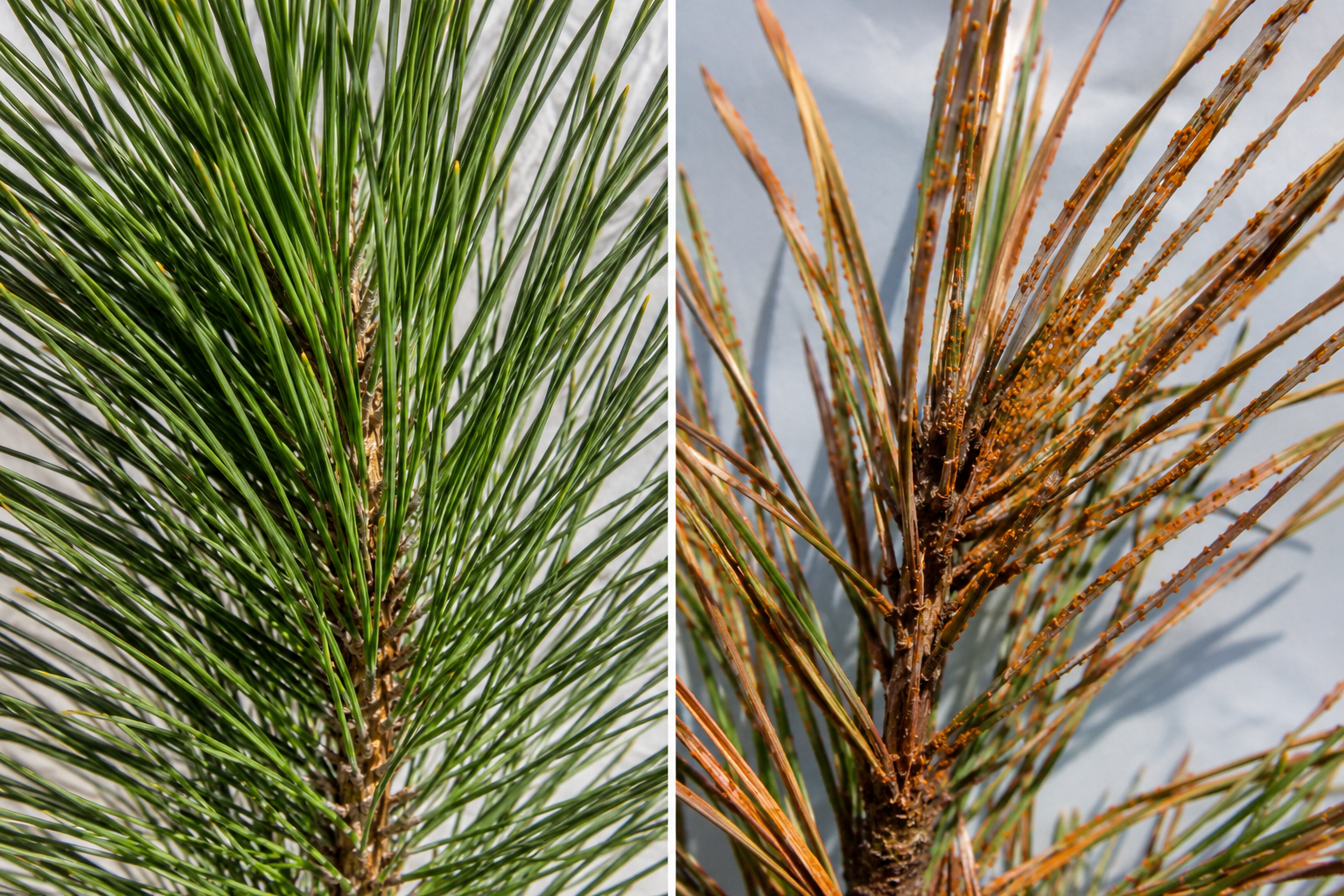
- Fusiform rust (Cronartium quercuum f. sp. fusiforme), causes spindle-shaped cankers on stems and branches; the most economically damaging pine disease in the South [2]
- Brown spot needle blight (Mycosphaerella dearnessii), causes brown spotting on needles, leading to premature needle drop; now considered the dominant emerging needle disease on loblolly [9]
- Annosus root rot (Heterobasidion irregulare), attacks root systems, often entering through fresh stumps
- Pitch canker (Fusarium circinatum), creates resinous cankers that girdle branches and stems
- Leptographium root disease, associated with bark beetle activity and kills fine roots
Any of these can kill a mature loblolly pine, but bark beetles are often the final blow after disease weakens the tree. Louisiana's hot, wet summers create ideal conditions for fungal spread. [5]
How to Identify Loblolly Pine Disease Symptoms
Most loblolly pine diseases show visible warning signs before the tree is beyond saving. The key is catching them early.
What to look for, from top to bottom:
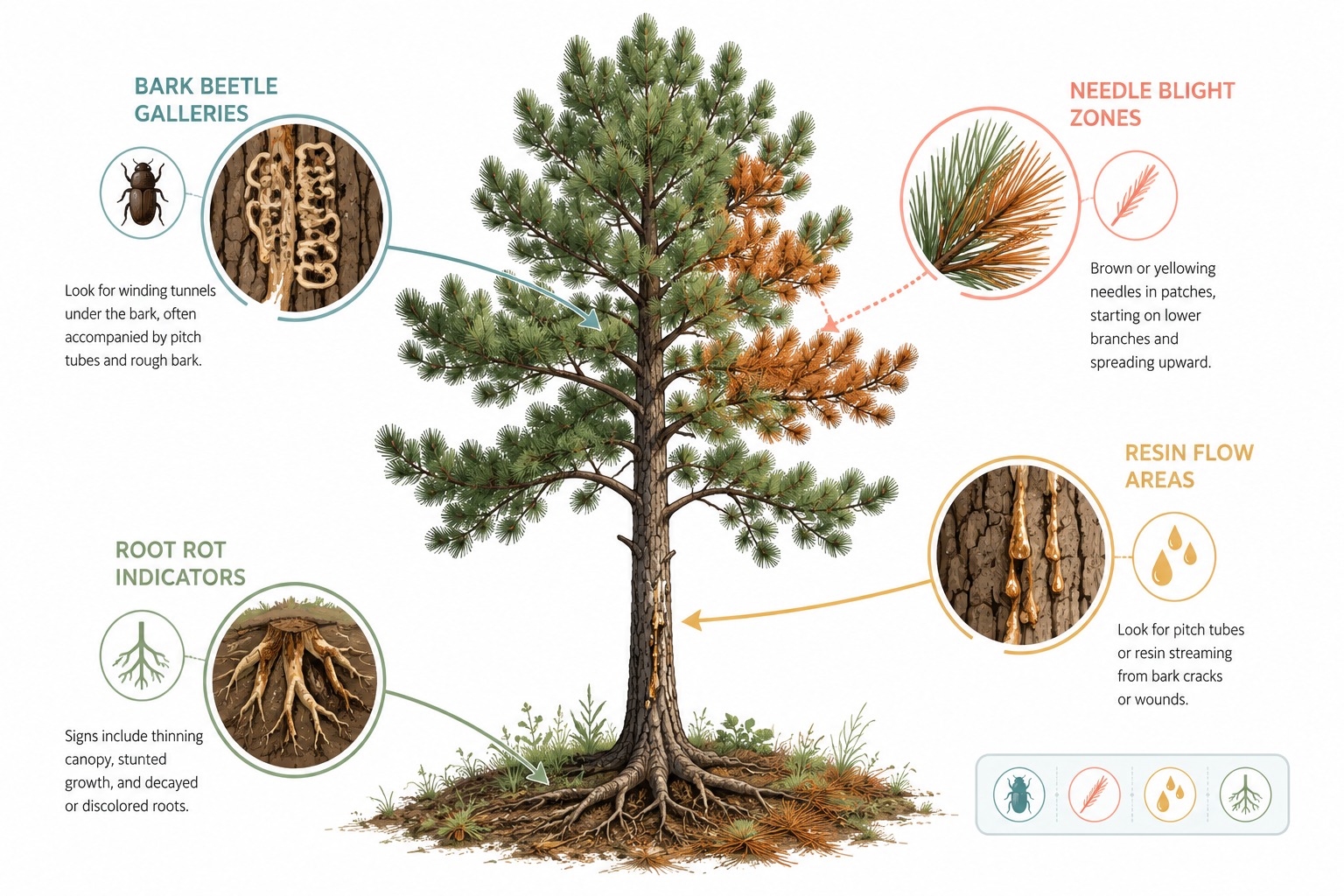
- Crown fade: Needles turning yellow, then brown, starting at the top of the tree. This is often the first visible sign of bark beetle infestation or root disease.
- Pitch tubes: Small, popcorn-sized masses of resin on the bark. These are the tree's response to bark beetle boring. Find them, and the beetles are already inside.
- Spindle-shaped swellings: Fusiform rust creates distinctive cigar-shaped galls on the main stem or branches. These are hard to miss once you know what you're looking for.
- Brown needle spots: Tan or brown bands across needles, sometimes with yellow halos. Classic brown spot needle blight.
- Basal resin flow: Thick resin weeping from the base of the tree often signals root disease or Annosus root rot.
- Blue-stained wood: If you cut into a branch and see blue-gray discoloration, that's a fungal stain carried by bark beetles. The tree is in serious trouble.
Common mistake: Homeowners in Broadmoor and South Highlands often mistake normal fall needle drop for disease. Loblolly pines shed their oldest needles every fall. The difference is location, natural shed starts from the inside of the crown, not the top.
What Causes Pine Needle Browning in Louisiana
Browning needles on a loblolly pine have several possible causes, and not all of them mean the tree is dying.
Most likely causes in Northwest Louisiana:
- Brown spot needle blight, fungal infection spreading from needle to needle during wet spring weather [9]
- Bark beetle activity, beetles disrupt water transport, causing rapid crown browning from the top down
- Drought stress, even brief dry spells in Caddo Parish summers can trigger needle browning on shallow-rooted pines
- Natural seasonal shed, inner and lower needles brown every fall; this is normal
- Herbicide drift, properties near agricultural areas around the Red River corridor sometimes see needle scorch from chemical drift
If browning starts at the top of the crown and moves downward quickly, treat it as an emergency. That pattern almost always means bark beetles or a vascular disease, not normal needle shed.
Loblolly Pine Bark Beetle Treatment Options
Bark beetles are the most urgent pine tree problem in Louisiana. Once beetles have fully colonized a tree, treatment cannot save it. Prevention and early intervention are the only effective strategies.
Treatment options by stage:
| Stage | What's Happening | What You Can Do |
|---|---|---|
| Pre-infestation | Tree is healthy or mildly stressed | Preventive insecticide bark spray (permethrin or bifenthrin-based products) |
| Early infestation | A few pitch tubes, no crown fade | Aggressive treatment possible; consult a licensed arborist |
| Mid-infestation | Crown yellowing, many pitch tubes | Treatment unlikely to succeed; removal recommended |
| Full infestation | Brown crown, blue-stained wood | Tree is dead or dying; remove promptly |
For preventive treatment on high-value trees, licensed pesticide applicators use bark spray applications before beetle season (typically March through June in Northwest Louisiana). This is not a DIY job, the chemicals require proper licensing and equipment.
If you have a diseased or dead pine near your home, prompt tree removal in Shreveport prevents the beetles from spreading to neighboring trees. Bark beetles can move fast through a stand once one tree goes down.
How to Prevent Fusiform Rust on Pine Trees
Fusiform rust cannot be cured once it infects a tree, but it can be managed and prevented in new plantings.
Fusiform rust requires two hosts to complete its life cycle: pine and oak. It spreads via wind-borne spores from oak leaves to pine needles each spring. [2] In Northwest Louisiana, where Water Oaks and Post Oaks grow alongside loblolly pines throughout neighborhoods like Spring Lake and Bossier City, the disease pressure is constant.
Prevention strategies:
- Plant disease-resistant loblolly varieties (see section below on resistant varieties)
- Maintain spacing between pines to improve air circulation and reduce humidity
- Remove heavily infected branches with cankers before they girdle the stem
- Avoid wounding trees during spring spore season
- Keep trees vigorous through proper watering during dry periods, stressed trees are far more susceptible [10]
Fungicide applications (triadimefon-based products) can protect young seedlings in nurseries and new plantings, but they are not practical or effective on established landscape trees. [4]
What Is the Difference Between Pine Wilt and Pine Beetles
Pine wilt and bark beetles are different problems, but they share symptoms and often occur together.
Pine wilt is caused by the pinewood nematode (Bursaphelenchus xylophilus), a microscopic roundworm transmitted by pine sawyer beetles. It causes rapid wilting and browning of the entire crown, often within weeks. Pine wilt is more common in ornamental pines (Scots, Austrian, Japanese black pine) than in loblolly.
Bark beetles (primarily Ips and Dendroctonus species) are insects that bore directly into the bark and phloem. They introduce blue-stain fungi that block water transport. Crown browning from bark beetles typically starts at the top and moves down over weeks to months.
Key differences:
- Pine wilt kills the whole crown rapidly and uniformly; bark beetles cause top-down browning
- Pine wilt is more common in ornamental pines; bark beetles are the primary threat to loblolly in Louisiana
- Both result in dead trees that need removal
In practice, a loblolly in Shreveport or Bossier City showing sudden full-crown browning is almost always bark beetles, not pine wilt. But a professional diagnosis matters before you invest in treatment. Our team at Shreveport Trees offers honest assessments, if it can be saved, we'll tell you. If it can't, we'll show you why.
When Should You Remove a Diseased Loblolly Pine Tree
Remove a diseased loblolly pine when the risk of failure outweighs the cost of treatment. That point comes sooner than most homeowners expect.
Remove the tree immediately if:
- More than 50% of the crown is brown or dead
- Blue-stained wood is visible under the bark
- The main stem has a fusiform rust canker that encircles more than half the circumference
- The tree is within striking distance of a structure, vehicle, or SWEPCO power line
- Basal resin flow suggests advanced root rot
- The tree has been dead for more than one season (wood decay accelerates failure risk)
You may have options if:
- Only lower branches are affected and the crown is still mostly green
- Fusiform rust cankers are on branches, not the main stem
- The tree is young (under 10 years) and the infection is isolated
For trees near homes in Broadmoor or along Cross Lake properties, the calculus is simple: a dead 70-foot loblolly that falls costs far more than a planned removal. Our emergency tree service handles situations where waiting isn't an option, but planned removal is always the safer and cheaper path. After removal, stump grinding eliminates the root system that can harbor Annosus root rot and spread it to neighboring trees.
Can Diseased Pine Trees Be Saved in Louisiana
Some diseased loblolly pines can be saved, but the window is narrow. Early-stage fusiform rust on branches, mild needle blight, and pre-infestation bark beetle pressure are all treatable with the right approach.
A tree is generally not saveable when:
- Bark beetles have colonized the main stem
- Root rot has destroyed the structural root system
- A fusiform rust canker has girdled the main trunk
- The crown is more than half dead
Honest answer: most loblolly pines that homeowners notice as "looking sick" are already past the point of practical treatment. The disease progressed for months before the symptoms were obvious. That's not a failure on the homeowner's part, it's just how these diseases work.
If there's any doubt, get a professional assessment before spending money on treatments that won't work. Contact Shreveport Trees for a free estimate and straight talk about what your tree actually needs.
How Much Does It Cost to Treat Pine Tree Disease
Treatment costs depend on the disease, tree size, and how early you catch it.
Rough cost ranges (Northwest Louisiana, 2026 estimates):
- Preventive bark beetle spray (per tree): $150 to $400 depending on tree size
- Fungicide treatment for needle blight (per tree, per season): $100 to $300
- Professional disease diagnosis/arborist consultation: $75 to $200
- Tree removal (diseased loblolly, 40-80 feet): $600 to $2,500 depending on location and complexity
- Stump grinding after removal: $100 to $300
The hard truth: treatment on a tree that's already in serious decline is money spent on a dying patient. A free estimate from a licensed arborist tells you which category your tree falls into before you spend a dollar on chemicals. For trees that need to come down, our tree removal service covers all of Caddo Parish and surrounding areas, with debris cleanup included or available as an add-on.
Why Are My Loblolly Pines Dying Suddenly
Sudden death in loblolly pines almost always points to bark beetles, and bark beetles almost always follow a stress event.
The pattern in Northwest Louisiana is consistent: a summer drought, a severe storm, a lightning strike, or construction damage weakens the tree's defenses. Bark beetles detect the stressed tree's reduced resin production and move in. Within weeks, pitch tubes appear. Within months, the crown browns. By the time most homeowners notice, the tree is gone.
Other causes of rapid decline:
- Lightning strike, damages vascular tissue and opens the tree to secondary infection
- Flooding, extended saturation around Cross Lake and Red River bottomlands suffocates roots
- Construction damage, soil compaction and root cutting from nearby work, common in developing areas of Bossier City and Haughton
- Herbicide damage, soil-applied herbicides can move to pine root zones
If multiple pines on your property are declining at the same time, suspect bark beetles spreading from tree to tree. Remove affected trees promptly and have neighboring trees assessed. Our team serves Haughton, Bossier City, and all of Northwest Louisiana, we know these trees because we live here too.
Best Fungicide for Louisiana Pine Trees
No single fungicide works across all pine tree diseases. The right product depends on the specific pathogen.
- Brown spot needle blight: Copper-based fungicides or chlorothalonil applied in early spring before spore release; timing is critical [9]
- Fusiform rust (seedlings/young trees): Triadimefon applied during the infection window (when oak leaves are emerging in spring) [4]
- Pitch canker: No effective fungicide; management focuses on pruning infected tissue and maintaining tree vigor
- Annosus root rot: Borax treatment applied to fresh stumps immediately after cutting prevents new infections [5]
Important: fungicide applications on mature landscape trees are rarely cost-effective for serious infections. They work best as preventive tools on young trees or as part of an integrated management plan for high-value specimens. Always use a licensed applicator for commercial-grade products.
How to Know If Your Pine Tree Has Root Rot
Root rot is the hardest pine disease to catch early because the damage is underground. By the time above-ground symptoms appear, the structural root system may already be compromised.
Warning signs of root rot in loblolly pines:
- Thin, sparse crown with small, pale needles despite no visible bark damage
- Resin bleeding from the base of the trunk at or below the soil line
- White fungal mycelium or conks (shelf-like mushrooms) at the base of the tree
- Tree leans slightly or rocks in wind more than it used to
- Neighboring stumps showing white rot, Annosus spreads through root-to-root contact [5]
A tree with advanced root rot is a structural failure waiting to happen. It may look mostly healthy from the street but have no anchoring capacity. This is especially dangerous for pines near homes in South Highlands or along wooded lots in Keithville. If you suspect root rot, don't wait, get a professional assessment. Our Keithville tree service team handles exactly these situations.
Loblolly Pine Disease-Resistant Varieties
Disease resistance is the most cost-effective long-term strategy for managing pine tree diseases in Louisiana.
Loblolly pine breeding programs have produced varieties with significantly improved resistance to fusiform rust. The USDA Forest Service and university cooperative programs have identified and released rust-resistant seed sources over the past several decades. [6]
What to look for when replanting:
- Seed sources from rust-resistant parent trees, available through reputable nurseries
- Slash pine as an alternative in wet areas, somewhat more resistant to certain diseases, though still susceptible to bark beetles
- Longleaf pine for dryer upland sites in Caddo Parish, more naturally resistant to several pathogens and historically the dominant pine species in the region [8]
If you're replanting after removing diseased trees, ask your nursery specifically about rust-resistance ratings. It's a simple question that can save significant problems 10 to 20 years down the road.
Who to Call for Pine Tree Disease Diagnosis in Louisiana
For accurate pine tree disease diagnosis in Northwest Louisiana, call a licensed, ISA-certified arborist with local experience. Not a landscaper. Not a general handyman.
A certified arborist can:
- Identify the specific disease or pest causing decline
- Assess whether treatment is viable or removal is the right call
- Provide documentation for insurance claims if storm damage is involved
- Recommend a treatment plan from licensed applicators
Shreveport Trees is licensed, insured, and local. We've diagnosed pine tree diseases and problems across Caddo Parish, Bossier City, and all of Northwest Louisiana. Our assessments are honest, we don't recommend treatment on trees that need to come down, and we don't recommend removal on trees that can be saved.
Call us for a free estimate. No obligation, no pressure.
Conclusion
Pine tree diseases and problems in Louisiana loblolly are serious, and they move fast. Bark beetles, fusiform rust, brown spot needle blight, and root rot can take a healthy 60-foot pine from stressed to dead in a single season. The homeowners who come out ahead are the ones who catch problems early and get straight answers from someone who knows Northwest Louisiana trees.
Your next steps:
- Walk your property this week and look for pitch tubes, browning crowns, and basal resin flow
- If you see any warning signs, don't wait, call a licensed arborist before the problem spreads
- For trees near structures, power lines, or SWEPCO easements, treat any signs of decline as urgent
- If removal is necessary, handle debris promptly to reduce beetle spread to neighboring trees
- When replanting, choose disease-resistant varieties suited to Caddo Parish conditions
Shreveport Trees serves Shreveport, Bossier City, and all of Northwest Louisiana. We know these trees because we live here too. Call us for a free estimate, real people, real fast, honest answers.
Serving Shreveport, Bossier City, and all Northwest Louisiana. Licensed. Insured. Local.
Frequently Asked Questions
Q: How fast can bark beetles kill a loblolly pine in Louisiana? A: In warm Louisiana summers, bark beetles can kill a stressed loblolly pine in as little as four to eight weeks after initial infestation. Once the crown turns brown, the tree is dead.
Q: Can I treat pine bark beetles myself? A: Preventive bark sprays are available to homeowners, but effective application on tall trees requires commercial equipment and licensed pesticide products. DIY treatment on an actively infested tree rarely works and wastes money.
Q: Is fusiform rust contagious between pine trees? A: Fusiform rust spreads via wind-borne spores from oak trees to pines each spring. It does not spread directly from pine to pine, but high oak density near your pines increases infection pressure every year.
Q: Should I remove a pine stump after taking down a diseased tree? A: Yes. Fresh stumps from trees infected with Annosus root rot can spread the disease to neighboring trees through root contact. Stump grinding and borax treatment of the stump surface are both recommended.
Q: How do I know if my pine tree's brown needles are disease or just normal fall shed? A: Normal needle shed starts from the inner crown and lower branches in fall. Disease-related browning typically starts at the top of the crown or appears as spotting on needles throughout the tree. Top-down browning is always a red flag.
Q: Are loblolly pines worth treating, or should I just remove and replant? A: It depends on the stage of disease and the tree's location. A young loblolly with early fusiform rust on branches may be worth treating. A mature tree with bark beetles in the main stem or advanced root rot should come down. Get a professional assessment before spending money on either option.
Q: How do I prevent pine diseases from spreading to my other trees? A: Remove dead and dying trees promptly, grind stumps of trees lost to root rot, avoid wounding healthy trees during spring spore season, and maintain tree vigor through proper care. Bark beetles spread fastest through stands of stressed trees, so keeping your healthy pines healthy is the best defense.
References
[1] Fungal Disease Threatens Pine Plantations In Arkansas Uams Arkansas Forest - https://www.ldaf.la.gov/about/news/article/fungal-disease-threatens-pine-plantations-in-arkansas-uams-arkansas-forest
[2] The Frightful Four The Top Forest Health Threats In The South Today - https://southernforests.org/2024/07/10/the-frightful-four-the-top-forest-health-threats-in-the-south-today/
[4] bugwoodcloud - https://bugwoodcloud.org/resource/files/31378.pdf
[5] La Fhh 2021 - https://www.fs.usda.gov/foresthealth/docs/fhh/LA_FHH_2021.pdf
[6] Ojf 1621138 - https://www.scirp.org/pdf/ojf_1621138.pdf
[8] Pub1618prescribedburninginpinelandslowres - https://www.lsuagcenter.com/NR/rdonlyres/546B99AE-FA73-4111-BD94-DAE7063AE7F5/68851/pub1618prescribedburninginpinelandsLOWRES.pdf
[9] Ffar Grant Addresses Emerging Pine Needle Diseases - https://www.morningagclips.com/ffar-grant-addresses-emerging-pine-needle-diseases/
[10] E4209e03 - https://www.fao.org/4/e4209e/E4209E03.htm
0 Comments