
Last updated: July 14, 2026
Quick Answer: Tree trimming preserves a living tree by cutting select branches to improve health, shape, or safety. Tree removal eliminates the entire tree when it poses a hazard, is dead or dying, or cannot be saved. The tree removal vs tree trimming difference comes down to one question: can this tree be kept safely, or does it need to go? Knowing which service you actually need saves you money and protects your property.
Key Takeaways
- Trimming keeps a tree alive and healthy. Removal takes the whole tree out, roots and all (or down to a stump).
- If more than 50% of a tree's canopy or trunk is damaged or diseased, removal is usually the right call. [5]
- Tree trimming typically costs far less than full removal, but skipping needed trimming often leads to a more expensive removal later. [2]
- Most trimming jobs don't require a permit in Caddo Parish. Removal often does, especially for protected or large-diameter trees.
- Dead trees cannot be "saved" by trimming. They need to come down.
- DIY trimming on branches above 10 feet carries serious injury risk. Professional equipment and training matter.
- Water Oaks, Loblolly Pines, and Chinese Tallows are the most common problem trees we see in Shreveport and Bossier City.
- A free estimate from a licensed, insured arborist is the fastest way to get a straight answer on what your tree actually needs.
What Is the Difference Between Tree Removal and Tree Trimming?
Tree trimming is selective branch removal on a living tree. Tree removal is the complete extraction of a tree from your property. These are two entirely different services with different goals, equipment, cost, and outcomes.
Trimming focuses on the canopy. A certified arborist removes dead, crossing, or overgrown branches to improve the tree's structure, reduce storm risk, or clear space from a roofline or power line. The tree stays in the ground and keeps growing.
Removal means the tree comes out entirely. A crew cuts the trunk in sections, removes all wood and debris, and leaves you with a stump (which can be ground down separately, see our stump grinding service for details). The tree is gone permanently.
The core distinction: trimming is about preservation, removal is about elimination. [1]
When Should You Remove a Tree vs Trim It?
Trim a tree when it's structurally sound and the problem is limited to specific branches. Remove a tree when the trunk, root system, or more than half the canopy is compromised.
Here's a practical decision framework:
Choose trimming if:
- Dead or crossing branches are isolated to one section of the canopy
- The tree is healthy but growing too close to your house, fence, or a SWEPCO power line
- You want to improve shape, light penetration, or fruit production on a Pecan or Magnolia
- The tree passed a structural inspection with no major trunk defects
Choose removal if:
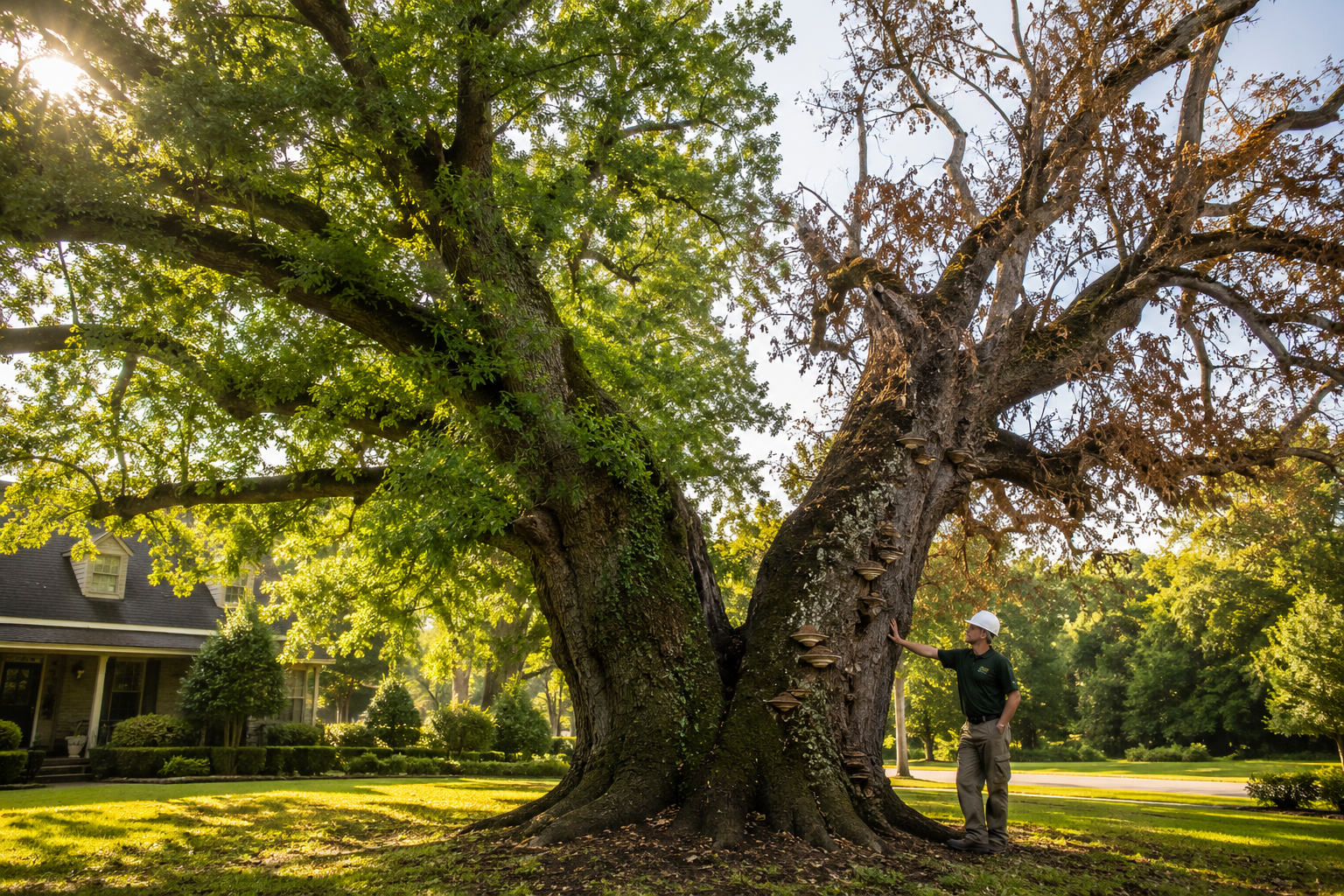
- The trunk shows large cracks, deep cavities, or signs of advanced decay
- More than 50% of the canopy is dead or severely damaged [5]
- The root system is lifting your foundation, driveway, or sewer line
- The tree is dead, full stop
- A storm has split the main trunk or caused a major lean toward your home
- The species is a Chinese Tallow or other invasive that's spreading aggressively
In Shreveport's South Highlands and Broadmoor neighborhoods, we see a lot of aging Water Oaks that fall into gray territory. They look alive, but the interior is rotting. That's not a trimming job. That's a removal waiting to happen, and the sooner it's done, the cheaper and safer it is.
What Are the Signs a Tree Needs to Be Removed?
A tree needs removal when it presents a safety hazard that trimming cannot fix. These are the warning signs we look for on every assessment.
Structural red flags:
- Large cracks or splits running vertically through the trunk
- Mushrooms or fungal growth at the base (indicates internal rot)
- Hollow sections in the trunk you can knock on and hear echo
- Leaning more than 15 degrees, especially toward a structure
- Exposed or heaving roots on one side (sign of root failure)
Canopy and health red flags:
- More than half the branches are bare or dead [5]
- Bark is falling off in large sections without new growth underneath
- The tree failed to leaf out for two consecutive springs
Location red flags:
- The tree is within striking distance of your home, and no amount of trimming removes the risk
- Roots are actively damaging underground utilities or your foundation
If you're in Bossier City or the Spring Lake area and you're seeing any of these signs, don't wait for the next storm to make the decision for you. Get a professional assessment. Our tree removal service in Shreveport covers the full process from assessment to cleanup.
How Much Does Tree Removal Cost Compared to Trimming?
Trimming is almost always cheaper than removal. Tree trimming typically runs $200,$800 for a standard residential tree, depending on size and access. Full tree removal ranges from $400 to $2,000 or more for large trees, with additional costs for stump grinding and debris hauling. [2] [4]
The cost gap comes from the complexity. Removal requires more equipment, more crew time, and more risk management. A large Loblolly Pine near a home in Keithville takes a skilled crew with a crane or bucket truck, careful sectional cutting, and full cleanup. That's a day's work.
Trimming the same tree, if it's healthy, might take two hours.
The long-term math is important here: Homeowners who skip routine trimming for five or ten years often end up paying for full removal when the tree becomes a hazard. Trim it now, or pay triple to remove it later. [7]
Permits also affect cost. In Caddo Parish, removing a tree above a certain trunk diameter may require a permit, which adds time and fees. Trimming rarely triggers permit requirements. Always ask your arborist before work begins.
Can You Trim a Tree Instead of Removing It?
Yes, if the tree is fundamentally healthy and the problem is branch-specific. No, if the trunk, root system, or majority of the canopy is compromised.
Trimming is not a substitute for removal when a tree is structurally unsafe. Cutting branches off a tree with a rotting trunk doesn't fix the trunk. It just makes the tree slightly lighter before it falls. [6]
A good rule: if trimming would require removing more than 25% of the living canopy in a single session, the tree may be too far gone to save through trimming alone. Over-pruning stresses a tree and can accelerate decline. [8]
If it can be saved, we'll tell you. If it can't, we'll show you why. That's the honest assessment every homeowner deserves before any work starts.
Tree Trimming vs Pruning: What's the Difference?
Trimming and pruning are often used interchangeably, but they have distinct purposes. Trimming typically refers to cutting back overgrown branches for aesthetic shape or clearance. Pruning is more targeted, it removes dead, diseased, or structurally weak wood to improve the tree's long-term health.
In practice:
- Trimming is what you do when branches are crowding your roofline or blocking a view
- Pruning is what a certified arborist does to a Pecan or Bald Cypress to improve structure, air circulation, and disease resistance
Both fall under professional tree trimming services, but the technique and timing differ. Pruning is best done in late winter before new growth starts. Trimming can be done year-round, though we avoid heavy cuts during peak summer stress in Northwest Louisiana.
The ANSI A300 standard governs professional pruning practices in the U.S., including specifications for cut placement, wound closure, and acceptable removal percentages. [3]
How Often Should Trees Be Trimmed?
Most residential trees in Northwest Louisiana benefit from trimming every 3-5 years. Fast-growing species like Water Oak and Sweetgum may need attention every 2-3 years. Slower-growing trees like Post Oak or Magnolia can often go 5-7 years between trims. [8]
Annual inspections are worth doing regardless. A quick look each spring, especially after our ice storm and hurricane seasons, catches problems before they become expensive.
Trees near power lines, structures, or high-traffic areas should be assessed more frequently. SWEPCO has its own trimming schedule for lines along rights-of-way, but that work is focused on clearance, not tree health. Your tree's health is your responsibility.
Is Tree Trimming Dangerous to Do Yourself?
Yes, above a certain height. Ground-level trimming of small branches under 10 feet is manageable for most homeowners with the right tools. Anything higher involves real fall risk, chainsaw hazards, and the possibility of a branch dropping in an uncontrolled direction.
Minimum tools needed for basic DIY trimming:
- Bypass hand pruners (for branches under 3/4 inch)
- Loppers (for branches up to 2 inches)
- Pruning saw (for branches 2-5 inches)
- Safety glasses and work gloves
For anything requiring a ladder, a chainsaw, or work near a power line, stop. The risk of injury or property damage outweighs the cost of hiring a professional. We're licensed, insured, and carry full liability coverage for exactly this reason.
For larger jobs across Northwest Louisiana, our teams serve Bossier City, Haughton, Benton, and surrounding communities.
Can a Dead Tree Be Trimmed, or Does It Need Removal?
A dead tree needs to be removed. Trimming a dead tree does not restore it, and it does not make it safer in the long run.
Dead wood is brittle and unpredictable. Branches can fall without warning. The root system of a dead tree begins to decay, which means the whole tree can topple in a moderate wind. In Louisiana's storm season, a dead tree near your home is not a question of "if", it's a question of when.
Some homeowners ask about "deadwooding", removing only the dead branches while leaving the live portions. That's a legitimate service for a tree that's partially alive. But if the entire tree is dead, removal is the only responsible answer. [6]
Does Tree Trimming Help a Sick Tree Survive?
Sometimes, yes. Removing diseased branches early can stop the spread of fungal infections, bacterial cankers, or insect infestations to healthy parts of the tree. This is especially true for Oak Wilt, which spreads through connected root systems and fresh pruning wounds, another reason to hire a certified arborist who knows local disease pressure.
Trimming also reduces the load on a stressed tree, allowing it to direct resources toward recovery rather than sustaining a large canopy.
But trimming cannot cure a tree with systemic disease, advanced root rot, or structural failure. If the problem is in the trunk or root system, no amount of branch work will fix it. An honest assessment tells you which situation you're in.
How Long Does Tree Removal Take?
Most residential tree removals in Shreveport take two to six hours, depending on tree size, location, and access. A straightforward 40-foot Loblolly Pine in an open backyard might be done in two hours. A 70-foot Water Oak tight against a house in Broadmoor, with limited equipment access, could take a full day.
Factors that extend the timeline:
- Trees over power lines (requires coordination with SWEPCO)
- Multiple trees in a single job
- Difficult access (fenced yards, narrow gates)
- Storm damage requiring extra caution around unstable sections
After the tree is down, debris removal and stump grinding are separate steps. Our tree debris cleanup service handles the full post-removal process so your yard is clean when we leave.
Frequently Asked Questions
Q: What is the main tree removal vs tree trimming difference? Trimming removes select branches from a living tree to improve health, safety, or appearance. Removal takes out the entire tree. Trimming preserves the tree; removal eliminates it permanently.
Q: Do I need a permit to remove a tree in Shreveport? It depends on the tree's size and location. Caddo Parish and the City of Shreveport have ordinances that may require permits for removing trees above a certain diameter, especially on commercial property or near protected areas. Always check before you cut. Your arborist should know the local rules.
Q: Can I trim a tree myself? For small branches under 10 feet, yes, with proper hand tools. For anything requiring a ladder, chainsaw, or work near power lines, hire a professional. The injury risk is not worth the savings.
Q: How do I know if my tree needs trimming or removal? If the trunk is sound and the problem is limited to specific branches, trimming is likely the right call. If the trunk is cracked, hollow, or rotting, or if more than half the canopy is dead, the tree probably needs to come down. A free assessment from a certified arborist gives you a definitive answer.
Q: Does homeowner's insurance cover tree removal? It depends on your policy and the circumstances. If a tree falls on your home due to a storm, most policies cover removal from the structure. If the tree falls in your yard without hitting anything, coverage varies. Call your insurer directly, and call us for the physical work.
Q: How much does tree trimming cost in Shreveport? Most residential trimming jobs run $200,$800 depending on tree size, species, and access. Large trees or those near structures cost more. We provide free estimates with no obligation and no pressure. [2] [4]
Conclusion
The tree removal vs tree trimming difference is not complicated once you know what to look for. Trim a tree when it's healthy and the problem is branch-specific. Remove a tree when the trunk, roots, or majority of the canopy is compromised beyond recovery.
The mistake most homeowners make is waiting. A tree that needed trimming three years ago may need full removal today, at three times the cost and ten times the risk. Don't let that happen to a 60-year-old Pecan or Magnolia on your property.
We know these trees because we live here too. Shreveport Trees provides honest assessments, fair pricing, and 24/7 emergency response across Northwest Louisiana, serving Shreveport, Bossier City, and all surrounding communities. Licensed. Insured. Local.
Call us at (318) XXX-XXXX or email info@shreveporttreeremoval.com for a free estimate, no obligation, no pressure. If your tree can be saved, we'll tell you. If it can't, we'll show you why.
References
[1] Tree Removal Vs Tree Trimming - https://robinsontree.net/tree-removal-vs-tree-trimming/
[2] Tree Removal Vs Trimming Cost - https://calculatetreecost.com/compare/tree-removal-vs-trimming-cost/
[3] Ansi A300 Clause 5 Expands Use Of Mechanical Pruning - https://tcimag.tcia.org/safety/equipment-safety-mechanization/ansi-a300-clause-5-expands-use-of-mechanical-pruning/
[4] Tree Trimming Cost - https://projectcostrange.com/outdoor/tree-trimming-cost/
[5] Tree Removal Vs Tree Trimming - https://treeremovalauthority.com/tree-removal-vs-tree-trimming
[6] Tree Removal Vs Tree Trimming - https://axeandwedge.co/blog/tree-removal-vs-tree-trimming
[7] Tree Removal Vs Tree Trimming How To Decide Safety Cost - https://www.americantree.info/post/tree-removal-vs-tree-trimming-how-to-decide-safety-cost
[8] Tree Trimming Vs Tree Removal - https://goodpeopletreeservice.com/tree-trimming-vs-tree-removal/
0 Comments