
Last updated: July 14, 2026
Quick Answer: Tree roots can damage your foundation through two main mechanisms, direct physical pressure and soil shrinkage from moisture extraction. The clearest warning signs are stair-step cracks in brick, sticking doors and windows, sloping floors, and gaps between soil and the foundation wall. Catching these signs early and acting on them, whether through root barriers, strategic tree removal, or professional foundation repair, can save you tens of thousands of dollars.
Key Takeaways
- Stair-step cracks in brick or block, doors that suddenly stick, and floors that slope toward an exterior wall are the top warning signs of tree root damage to a foundation.
- Roots rarely punch through solid concrete directly. The bigger threat is soil shrinkage: roots pull moisture from clay-heavy soil, causing the ground to contract and the foundation to settle unevenly.
- Water Oaks, Sweetgums, Willows, and Silver Maples are the most aggressive root offenders near homes in Northwest Louisiana.
- Trees should be planted no closer than their mature canopy radius to any structure, for a large Water Oak, that means 20 to 30 feet minimum.
- Root barriers work best as prevention. Once roots are already under a footing, removal is the more reliable fix.
- Foundation repair from tree root damage runs anywhere from $2,000 for minor crack sealing to $15,000 or more for pier installation, depending on severity.
- Most homeowners insurance policies exclude gradual tree root damage. Coverage depends heavily on your policy language.
- If a tree is actively damaging your foundation, removing it and grinding the stump is the cleanest long-term solution.
What Are the Main Signs of Tree Root Damage to a Foundation
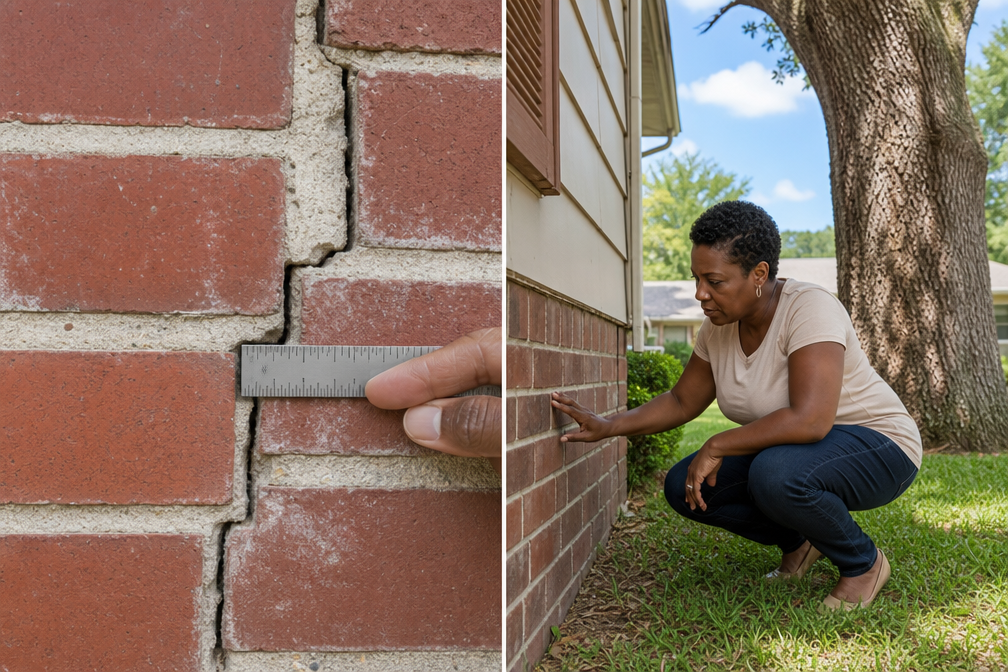
The clearest signs are stair-step cracks in brick or block walls, horizontal cracks along mortar lines, floors that slope noticeably toward an exterior wall, doors and windows that stick or no longer close square, and visible gaps at wall-to-ceiling junctions. You may also notice the soil pulling away from the foundation on the side closest to a large tree, sometimes a gap of one to three inches during dry spells.[1][6]
A simple field test: place a marble on your floor near an exterior wall. If it rolls consistently toward that wall, the foundation has settled on that side. That's worth a professional look.[5][8]
High-priority warning signs that need immediate attention:
- Cracks wider than 1/4 inch, especially if they're still widening [8]
- Stair-step cracks that follow mortar lines in brick (classic sign of differential settlement)
- Multiple sticking doors or windows on the same side of the house
- Visible root mass within three to five feet of the foundation
- Floors that feel noticeably springy or sloped near exterior walls [9]
Seasonal patterns matter too. If cracks worsen during Shreveport's dry summers and ease after rain, that points directly to root-driven soil shrinkage, not a random settling issue.[1][6]
How Do Tree Roots Actually Damage Concrete Foundations
Tree roots damage foundations primarily through soil manipulation, not brute force. Roots from large trees, especially Water Oaks and Sweetgums common across Broadmoor and South Highlands, extract enormous amounts of moisture from the clay-heavy soils typical of Caddo Parish. When that clay dries out, it shrinks. The foundation loses uniform support and begins to settle unevenly, causing cracks and structural stress.[7][10]
The second mechanism is physical displacement. Roots grow toward moisture and follow the path of least resistance. If a root finds a small crack or joint in a foundation, it can widen that opening over time as it thickens.[4][6]
Northwest Louisiana's expansive clay soils make this worse than in many other regions. The soil swells when wet and contracts sharply when dry, and our summers are long and brutal.
Can Tree Roots Actually Break Through a Foundation
Direct root penetration of solid, intact concrete is rare. Roots are opportunistic, they exploit existing weaknesses like cracks, expansion joints, or gaps around utility penetrations, then widen those openings as they grow.[4][7]
The more accurate picture: roots don't usually break through a foundation from scratch. They find a crack that's already there, from normal settling, poor construction, or age, and make it significantly worse. The result looks like a root "broke through," but the entry point was already compromised.[2][10]
Bottom line: If your foundation is in good condition with no existing cracks or gaps, roots are unlikely to punch through it. But no foundation stays perfect forever, and that's when roots become a serious problem.
What Trees Are Most Likely to Damage Foundations in Northwest Louisiana
Aggressive, moisture-hungry trees with wide, shallow root systems pose the greatest risk. In Shreveport and across Northwest Louisiana, the worst offenders are:
- Water Oak, extremely common in older neighborhoods like Spring Lake and South Highlands, fast-growing, and notorious for surface roots that spread far beyond the canopy
- Sweetgum, shallow, aggressive roots that lift sidewalks and damage footings
- Chinese Tallow, invasive, fast-growing, and not worth keeping near any structure
- Willow species, roots actively seek water sources, including plumbing and foundation drainage
- Silver Maple, common in older Bossier City lots, shallow root system, significant moisture draw
Trees that are generally lower-risk near foundations include Crape Myrtles, Dogwoods, and properly placed Magnolias. Loblolly Pines and Pecan trees fall in the middle, they can cause problems if planted too close, but they're less aggressive than Water Oaks.
If you're unsure what you're dealing with, our team offers professional tree removal and assessment services in Shreveport with honest evaluations, no upselling.
How Far from the House Should a Tree Be Planted
The general rule: plant a tree no closer to your foundation than its expected mature canopy radius. For a large tree like a Water Oak that spreads 40 to 50 feet wide at maturity, that means planting at least 20 to 25 feet from any structure.[6][10]
| Tree Type | Minimum Distance from Foundation |
|---|---|
| Small ornamental (Crape Myrtle) | 8-10 feet |
| Medium tree (Pecan, Post Oak) | 15-20 feet |
| Large tree (Water Oak, Sweetgum) | 20-30 feet |
| Willow or Silver Maple | 30-50 feet |
These are minimums. More distance is always better, especially on properties with clay-heavy soil near Cross Lake or along the Red River bottom.
What's the Difference Between Foundation Settling and Tree Root Damage
Normal foundation settling produces small, hairline vertical cracks, usually near corners, and happens gradually over years. Tree root damage tends to produce stair-step or horizontal cracks, concentrated on the side of the house closest to the tree, and often worsens during dry periods.[5][8]
Key diagnostic differences:
- Root damage cracks tend to appear or worsen in summer and improve after heavy rain
- Root damage often affects one side of the house more than others
- Soil gaps on the tree side of the foundation during dry spells strongly suggest root moisture extraction [1][6]
- Normal settling is usually uniform across the structure
If you're seeing cracks on one side of the house near a large tree, and those cracks track with dry weather, that's root damage until proven otherwise. Get a foundation specialist and a certified arborist to assess it together.
How Much Does Foundation Repair from Tree Root Damage Cost
Foundation repair costs vary widely based on severity. Minor crack sealing runs $500 to $2,500. Pier installation, needed when the foundation has shifted significantly, typically costs $1,000 to $3,000 per pier, and most jobs require multiple piers. Full foundation repair for serious root-related damage can reach $15,000 or more.[2][8]
That's before you factor in tree removal, stump grinding, and any landscaping work. Our stump grinding service in Shreveport removes the root system's growth engine, which is a critical step before foundation repair begins.
The honest math: a $1,500 tree removal today beats a $12,000 foundation repair next year.
Can You Remove Tree Roots Without Killing the Tree
Sometimes, but it depends on which roots and how many. Cutting roots within the critical root zone, roughly one foot of radius for every inch of trunk diameter, can destabilize or kill the tree.[7]
Root pruning works best as a preventive measure when roots are still small and haven't reached the foundation. Once large structural roots are near or under a footing, cutting them creates two problems: it may not stop the damage, and it can make the tree unstable enough to fall.
If the roots are already under your foundation, the cleanest solution is usually professional tree removal followed by stump grinding. Trying to save a tree that's actively damaging your home is a gamble most homeowners lose.
What's the Best Way to Prevent Tree Root Foundation Damage
Prevention is straightforward when you plan ahead. The main strategies:
- Plant the right tree in the right place. Choose species with less aggressive root systems and give them adequate distance from structures.
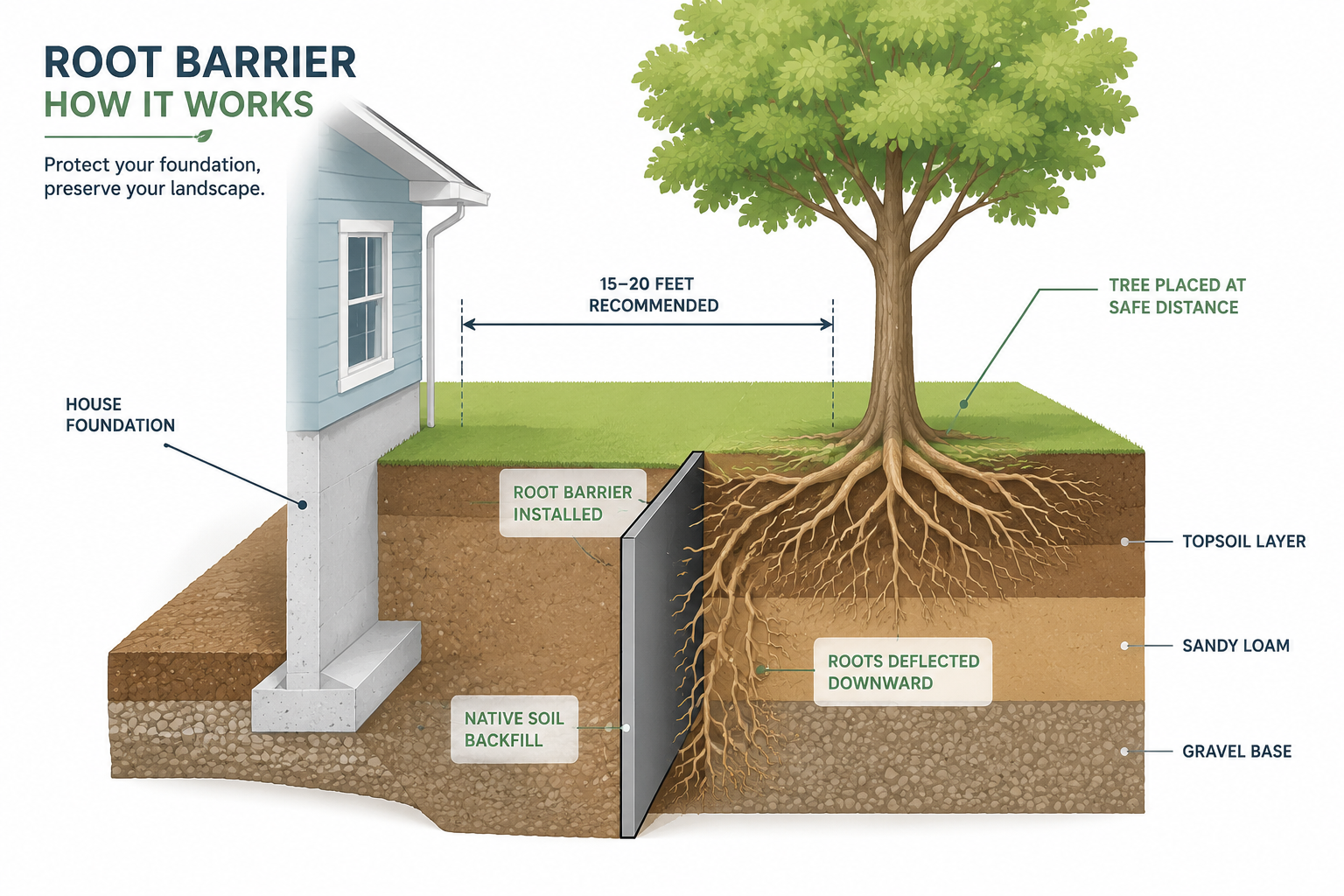
- Install root barriers before planting. Deep-set linear barriers (at least 24 to 30 inches) redirect roots downward and away from foundations.
- Maintain soil moisture consistently. Drip irrigation near large trees during dry months reduces the moisture gradient that pulls roots toward your home.
- Schedule regular tree assessments. Catching a root problem early, before it reaches the footing, is far cheaper than reacting to foundation damage. Our tree trimming and care services include root zone evaluations.
- Remove problem trees proactively. If you have a large Water Oak within 15 feet of your foundation in Shreveport, an honest assessment may tell you it needs to come down before it costs you.
Can Tree Root Barriers Actually Stop Foundation Damage
Root barriers work well as a preventive tool. Installed before roots reach the foundation, typically a solid HDPE or metal panel driven 24 to 36 inches deep along the property line between the tree and structure, they redirect root growth downward and away.[6][10]
What they don't do: stop roots that are already past the barrier, fix existing damage, or work well when installed too shallow. A 12-inch barrier in Caddo Parish clay is nearly useless, roots will go around or under it within a few seasons.
For existing mature trees already close to a foundation, a barrier is a partial measure at best. Combine it with regular root pruning by a certified arborist and annual monitoring.
Should You Cut Down a Tree That's Damaging Your Foundation
If the tree is actively causing measurable foundation damage and is too close to move, yes, it needs to come down. This isn't a decision to delay. Every growing season adds more root mass, more moisture extraction, and more structural stress.[1][4]
That said, not every tree near a crack is the cause. Get an honest assessment first. At Shreveport Trees, the answer is always: if it can be saved, we'll tell you. If it can't, we'll show you why.
If removal is the call, pair it with professional stump grinding. A stump left in place continues to decay and can create voids under the soil that cause additional settling. See our complete stump removal service for what that process looks like.
For storm-related emergencies where a tree has already caused damage, our 24/7 emergency tree service covers Shreveport, Bossier City, and all of Northwest Louisiana, real people, real fast.
Is Tree Root Foundation Damage Covered by Homeowners Insurance
Usually not. Most standard homeowners insurance policies exclude damage caused by tree roots because it's considered gradual deterioration rather than a sudden, accidental event. Some policies have specific exclusions for "earth movement" that also apply.[2][8]
Exceptions to watch for:
- If a tree falls and the roots cause immediate structural damage during a storm event, that may be covered as storm damage
- Some policies cover the cost of removing a fallen tree that damaged a structure
- Flood insurance (separate from standard homeowners) may cover related water intrusion in some cases
Read your policy carefully and call your agent before assuming you're covered. In our experience working across Caddo Parish and Bossier City, homeowners are often surprised to find root damage isn't covered until they're already facing a large repair bill.
How Long Does It Take for Tree Roots to Damage a Foundation
Root damage is slow at first and then accelerates. A tree planted five to ten feet from a foundation can begin affecting soil moisture within three to five years. Visible foundation cracks from root activity typically appear after ten to twenty years, depending on tree species, soil type, and rainfall patterns.[4][7]
Water Oaks in Shreveport's clay soils can reach aggressive root spread within eight to twelve years of planting. By the time cracks appear, the root system may already extend well under the footing.
This is why annual tree assessments matter. Catching a problem at year seven is a root barrier conversation. Catching it at year fifteen may be a foundation repair conversation.
Frequently Asked Questions
Can a tree root grow under a slab foundation? Yes. Roots follow moisture and will grow under slab foundations, particularly along the edges and through any existing gaps or cracks. Clay soils common in Northwest Louisiana make this more likely because moisture concentrates near the cooler, shaded underside of slabs.[6][10]
How do I know if my foundation cracks are from tree roots or something else? Look at the pattern and timing. Stair-step cracks in brick concentrated on one side of the house, worsening in dry weather and near a large tree, strongly suggest root activity. Uniform hairline vertical cracks across the whole structure are more consistent with normal settling. When in doubt, get both a foundation specialist and a certified arborist to look at it.[5][8]
Do dead or dying trees still damage foundations? A dead tree stops actively extracting moisture, which can actually cause the soil to re-expand, sometimes creating new movement in a foundation that had adjusted to drier conditions. Dead roots also decay and leave voids. Remove dead trees and grind the stumps promptly.[4]
What's the fastest-growing tree root threat in Shreveport? Chinese Tallow and Silver Maple are both fast-growing with aggressive root systems. Chinese Tallow in particular spreads quickly and is invasive, it has no place near a foundation and minimal ecological value in Northwest Louisiana. If you have one close to your home, it should come down.
Can I just cut the roots I can see on the surface? Surface root cutting is a temporary cosmetic fix. The roots you see are a fraction of the total system. Cutting them without addressing the tree's proximity to the foundation doesn't stop the underlying problem and may stress the tree enough to create a fall hazard.
How often should I have trees near my foundation inspected? Annually, especially for trees within 20 feet of any structure. Spring is a good time, before the dry summer season when root activity and soil shrinkage are most pronounced. Our team serves Shreveport, Bossier City, and surrounding communities including Benton, Haughton, and Blanchard.
Conclusion
Tree root damage to foundations is one of those problems that announces itself quietly, a sticky door here, a hairline crack there, and then becomes expensive fast. In Shreveport and across Northwest Louisiana, our clay soils and mature tree canopies make this a real and common issue, not a theoretical one.
The action steps are clear:
- Walk your foundation perimeter today. Look for stair-step cracks, soil gaps, and any large roots within 15 feet of the footing.
- Note which side of the house shows the most cracking and whether it gets worse in dry weather.
- If you have a Water Oak, Sweetgum, or Chinese Tallow within 20 feet of your home, get it assessed.
- Don't wait for the crack to widen. The cost curve on foundation damage is steep.
Shreveport Trees offers free estimates with no obligation and no pressure. We're licensed, insured, and local, we know these trees because we live here too. Call us at (318) XXX-XXXX or contact us online to schedule your assessment. Your trees, our responsibility.
References
[1] Tree Roots Damaging Foundation - https://www.mcdonaldtree.com/blog/tree-roots-damaging-foundation [2] How Tree Roots Can Damage Your Foundation And What You Can Do About It - https://allcountywaterproofing.com/2025/07/09/how-tree-roots-can-damage-your-foundation-and-what-you-can-do-about-it/ [4] Tree Root Damage Foundations - https://hobarttreeremovers.com.au/blog/tree-root-damage-foundations [5] Tree Roots Damaging Foundation - https://richmondtree.com/tree-roots-damaging-foundation/ [6] Tree Roots Foundation Damage Signs Prevention - https://levelhomefoundationrepair.com/tree-roots-foundation-damage-signs-prevention/ [7] Question Can Tree Roots Cause Damage To A Homes Foundation - https://www.purdue.edu/fnr/extension/question-can-tree-roots-cause-damage-to-a-homes-foundation/ [8] Tree Roots Damaging Foundation - https://heliconusa.com/tree-roots-damaging-foundation/ [9] Tree Roots Foundation Damage 5 Warning Signs You Cant Ignore - https://diamondbasementwaterproofing.com/tree-roots-foundation-damage-5-warning-signs-you-cant-ignore/ [10] Tree Roots Foundation Damage Prevention - https://ritewayfoundation.com/tree-roots-foundation-damage-prevention/
0 Comments